
 Dr. G. O. C. Okwuibe
Intelligence Report
W5 · 2026
Dr. G. O. C. Okwuibe
02 Feb 2026
Battery Arbitrage Opportunity — Week 05, 2026
Large wholesale electricity price spreads created a strong battery trading opportunity in Germany during Week 05. EUnix Market Intelligence identified 34 high-value operating hours, while the maximum daily charging-to-discharging spread reached €197.46/MWh.
📈
Charts
📊
Market Overview
EUnix Market Intelligence identified Battery Arbitrage Opportunity as the leading market story for ISO Week 05, covering 26 January to 1 February 2026.
The story received a priority score of 84.6, supported by a strong battery-opportunity signal of 94.1 and price-volatility score of 76.6. Overall detection strength reached 85.4%, with 66.2% confidence.
The central market signal was a maximum daily arbitrage spread of €197.46/MWh, accompanied by 34 hours of strong charging or discharging opportunities.
Interestingly, negative prices played no role in the event. The negative-price analytics score was 0, indicating that the opportunity came from substantial positive-price variation rather than electricity prices falling below zero.
The story received a priority score of 84.6, supported by a strong battery-opportunity signal of 94.1 and price-volatility score of 76.6. Overall detection strength reached 85.4%, with 66.2% confidence.
The central market signal was a maximum daily arbitrage spread of €197.46/MWh, accompanied by 34 hours of strong charging or discharging opportunities.
Interestingly, negative prices played no role in the event. The negative-price analytics score was 0, indicating that the opportunity came from substantial positive-price variation rather than electricity prices falling below zero.
🔍
Key Observations
1
The maximum daily arbitrage spread reached €197.46/MWh, making Monday the strongest theoretical arbitrage day of the week.
2
Wholesale electricity prices reached approximately €302.8/MWh, while the weekly minimum fell to around €84.1/MWh.
3
EUnix analytics identified 34 strong opportunity hours, providing distinct charging and discharging windows.
4
The strongest price volatility occurred early in the week, with arbitrage spreads progressively declining toward the weekend.
5
No negative-price event was detected, demonstrating that battery arbitrage does not require negative electricity prices to create value.
🧠
Interpretation
The hourly price structure created clearly separated operating windows.
Lower-price periods provided opportunities to charge, while subsequent high-price periods created potential discharge windows. Monday through Thursday contained the most attractive combinations, while the opportunity weakened considerably toward the weekend.
The daily arbitrage spread illustrates this clearly: the spread started at approximately €197.5/MWh on Monday, remained above €100/MWh on Tuesday, and declined to approximately €52/MWh by Sunday.
For battery operators, this matters more than simply observing the weekly maximum electricity price. Storage economics depend on the spread between the price at which energy is acquired and the price at which it can later be sold, after accounting for efficiency losses and operating constraints.
Week 05 represents a classic price-volatility-driven storage opportunity.
The absence of negative prices is particularly noteworthy. Battery value was generated through recurring differences between relatively low and high positive wholesale prices rather than exceptional negative-price events.
For storage operators, this reinforces the importance of intraday price structure and dispatch optimisation, rather than focusing only on extreme market events.
The declining spreads later in the week also demonstrate why static charging and discharging schedules can leave value on the table. Operating decisions need to respond to changing market conditions and the expected value of preserving battery capacity for later opportunities.
Lower-price periods provided opportunities to charge, while subsequent high-price periods created potential discharge windows. Monday through Thursday contained the most attractive combinations, while the opportunity weakened considerably toward the weekend.
The daily arbitrage spread illustrates this clearly: the spread started at approximately €197.5/MWh on Monday, remained above €100/MWh on Tuesday, and declined to approximately €52/MWh by Sunday.
For battery operators, this matters more than simply observing the weekly maximum electricity price. Storage economics depend on the spread between the price at which energy is acquired and the price at which it can later be sold, after accounting for efficiency losses and operating constraints.
Week 05 represents a classic price-volatility-driven storage opportunity.
The absence of negative prices is particularly noteworthy. Battery value was generated through recurring differences between relatively low and high positive wholesale prices rather than exceptional negative-price events.
For storage operators, this reinforces the importance of intraday price structure and dispatch optimisation, rather than focusing only on extreme market events.
The declining spreads later in the week also demonstrate why static charging and discharging schedules can leave value on the table. Operating decisions need to respond to changing market conditions and the expected value of preserving battery capacity for later opportunities.
💰
Revenue Insight
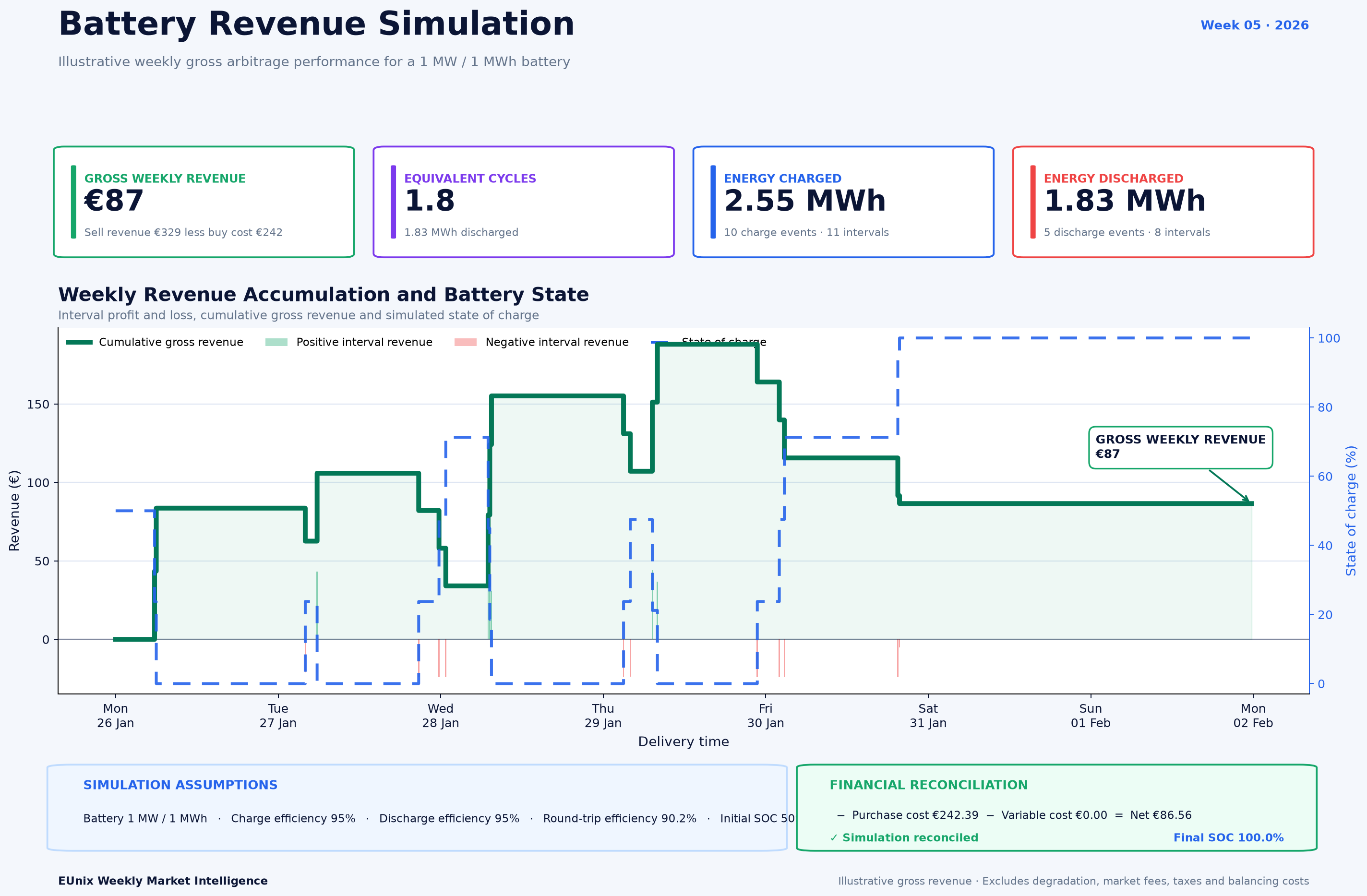
To examine whether the identified market opportunity could translate into actual battery value, EUnix simulated the operation of a 1 MW / 1 MWh battery with 95% charging efficiency and 95% discharging efficiency.
The simulation produced approximately €87 of gross weekly arbitrage revenue, with 2.55 MWh charged, 1.83 MWh discharged, and approximately 1.8 equivalent cycles.
The simulated battery charged at an average price of approximately €95.0/MWh and discharged at approximately €179.9/MWh, producing a realised price spread of €84.9/MWh.
This result also demonstrates an important distinction between market opportunity and realisable asset revenue. A theoretical daily spread approaching €200/MWh does not mean a battery can capture the entire spread. State of charge, efficiency, timing, power and energy capacity, and available operating windows determine how much of the market opportunity can actually be monetised.
The simulation is illustrative gross arbitrage performance and excludes degradation, market fees, taxes, balancing costs and other commercial considerations.
🔭
Market Outlook
The key signal to monitor following Week 05 is whether large daily spreads persist.
Sustained volatility would continue to support energy-arbitrage strategies, while narrowing spreads would reduce standalone arbitrage value and increase the importance of combining wholesale-market participation with FCR, aFRR or other flexibility revenue streams.
For upcoming weeks, EUnix Market Intelligence will continue tracking price spreads, charging and discharging windows, volatility, negative-price periods and simulated battery dispatch performance.
Sustained volatility would continue to support energy-arbitrage strategies, while narrowing spreads would reduce standalone arbitrage value and increase the importance of combining wholesale-market participation with FCR, aFRR or other flexibility revenue streams.
For upcoming weeks, EUnix Market Intelligence will continue tracking price spreads, charging and discharging windows, volatility, negative-price periods and simulated battery dispatch performance.
🔬
Simulation Note
All underlying electricity-market data used in this analysis were sourced from the ENTSO-E Transparency Platform. Data processing, market analytics, opportunity detection, battery dispatch simulation, visualisation and interpretation were performed using the EUnix Nexus Market Intelligence framework.
The battery revenue results represent an illustrative simulation and should not be interpreted as realised or guaranteed commercial returns.
Written by
Dr. G. O. C. Okwuibe
Quantitative Energy Systems Expert | Electricity Market & BESS
Dr. Godwin Okwuibe is a quantitative energy system expert specializing in electricity markets, battery storage optimization, and flexibility market design. His work focusses on translating complex market dynamics into actionable insights for industry stakehold...
godwin.okwuibe@eunixnexus.com
godwin.okwuibe@gmail.com
https://www.linkedin.com/in/godwin-c-okwuibe-ph-d-1b37b680
View full profile