
 Dr. G. O. C. Okwuibe
Battery Arbitrage Opportunity — Week 18, 2026
Extreme price separation created one of the strongest battery-arbitrage signals observed in the reporting period during Week 18. EUnix Market Intelligence detected a maximum daily arbitrage spread of €409.22/MWh, 34 strong opportunity hours, and wholesale prices ranging from €202.2/MWh to -€250.0/MWh. An illustrative 1 MW / 1 MWh battery simulation produced €1,112 gross weekly revenue, highlighting the commercial significance of the week’s volatility.
Charts
Market Overview
The story received a priority score of 95.60, supported by an exceptionally strong detection strength of 98.54% and confidence of 95.60%.
The dominant signal was a maximum daily arbitrage spread of €409.22/MWh, while 34 hours were identified as strong battery-opportunity periods.
Supporting analytics were also exceptionally strong. Negative prices scored 100, followed by battery opportunity at 95.98 and price volatility at 90.44. The story-intelligence assessment also showed severity of 99.5, impact of 100, opportunity/risk of 87.5, and novelty of 91.3.
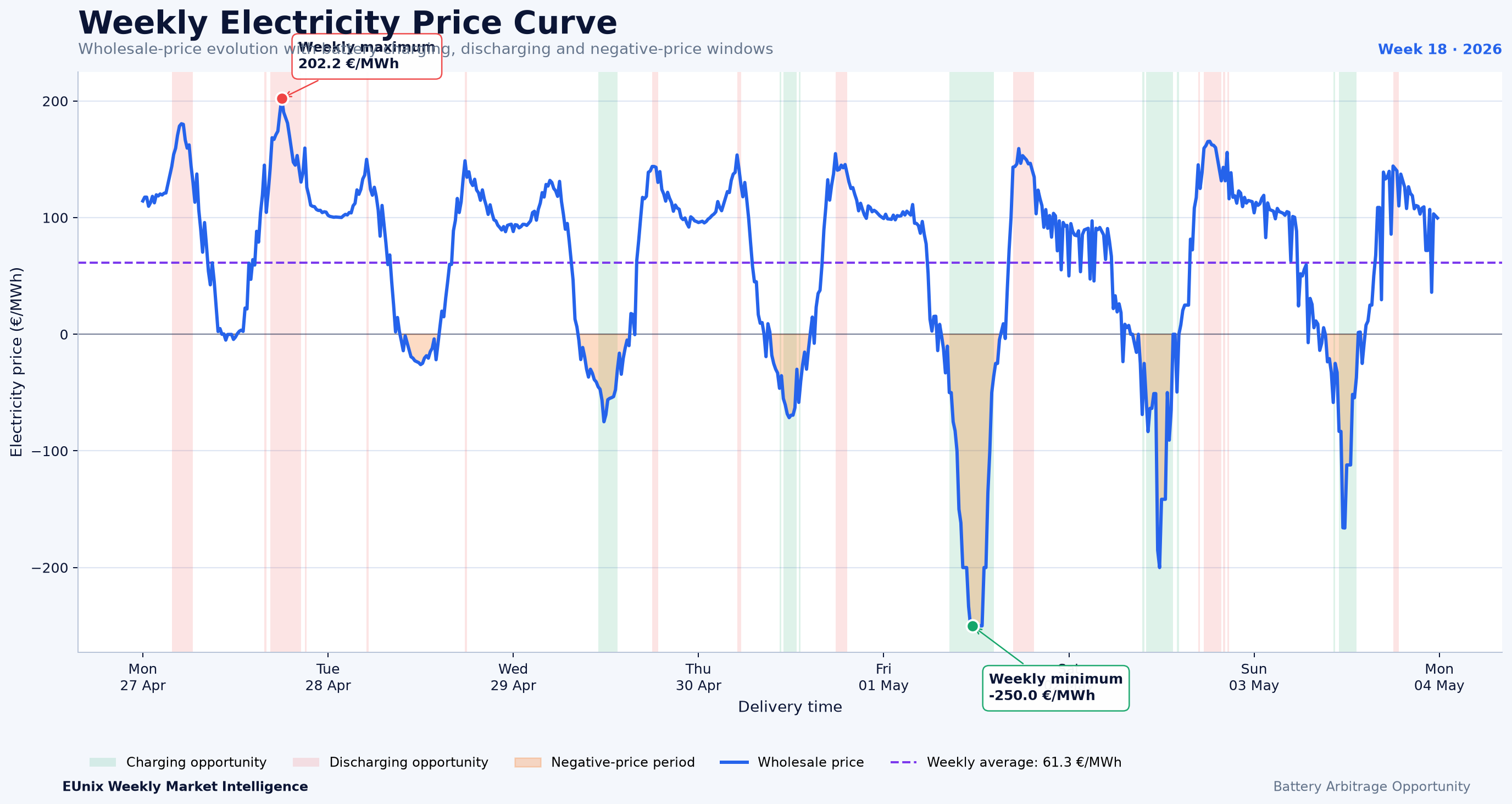
The wholesale-price curve demonstrates why the arbitrage signal was so strong. Prices reached a weekly maximum of approximately €202.2/MWh, while the minimum fell to -€250.0/MWh. The weekly average price was approximately €61.3/MWh.
This combination of deeply negative charging periods and high positive-price discharge periods created unusually favourable conditions for energy storage.
Key Observations
Interpretation
Traditional arbitrage involves buying electricity cheaply and selling it later at a higher price. Negative pricing creates an additional mechanism: a battery can receive economic value while charging because consuming electricity helps absorb excess supply.
That effect was particularly important this week.
With wholesale prices falling as low as -€250/MWh, the value of battery charging was not limited to preparing energy for later discharge. Under the simulated dispatch, negative-price periods themselves contributed positively to gross revenue.
The subsequent return to strongly positive electricity prices then created a second source of value through discharge.
This explains why the realised simulated charging price fell to approximately -€73.7/MWh, while the average discharge price reached €148.3/MWh. The resulting realised spread of €222/MWh created exceptionally favourable conditions for short-duration battery arbitrage.
The opportunity timeline also indicates that this was not simply one exceptional price spike. Charging and discharging windows appeared repeatedly across the reporting week, allowing the battery to complete approximately five equivalent cycles.
That recurrence matters commercially. A single extreme spread may look attractive statistically, but repeated monetisable windows are much more important when assessing actual battery economics.
Revenue Insight
Market Outlook
The weekly average price was approximately €61.3/MWh, which alone would not reveal the scale of the battery opportunity. The economic signal instead came from the extreme dispersion around that average—from -€250/MWh to €202.2/MWh.
For storage operators, the most important indicators to monitor are therefore maximum and minimum prices, duration of negative-price periods, daily arbitrage spreads, opportunity-window frequency and achievable realised charging and discharge prices.
Future weeks combining deep negative-price periods with strong evening or peak-price recovery would continue to favour battery arbitrage.
Conversely, if negative prices remain frequent but subsequent recovery weakens, the technical opportunity to absorb surplus electricity may remain while the monetisable arbitrage spread becomes less attractive.
The broader Week 18 message is clear: price volatility—not simply high electricity prices—is the key economic resource for merchant battery storage.
Simulation Note
Written by
Dr. G. O. C. Okwuibe
Quantitative Energy Systems Expert | Electricity Market & BESS
Dr. Godwin Okwuibe is a quantitative energy system expert specializing in electricity markets, battery storage optimization, and flexibility market design. His work focusses on translating complex market dynamics into actionable insights for industry stakehold...