
 Dr. G. O. C. Okwuibe
Import Dependency Event: Cross-Border Supply Became a Critical Feature of Week 8, 2026
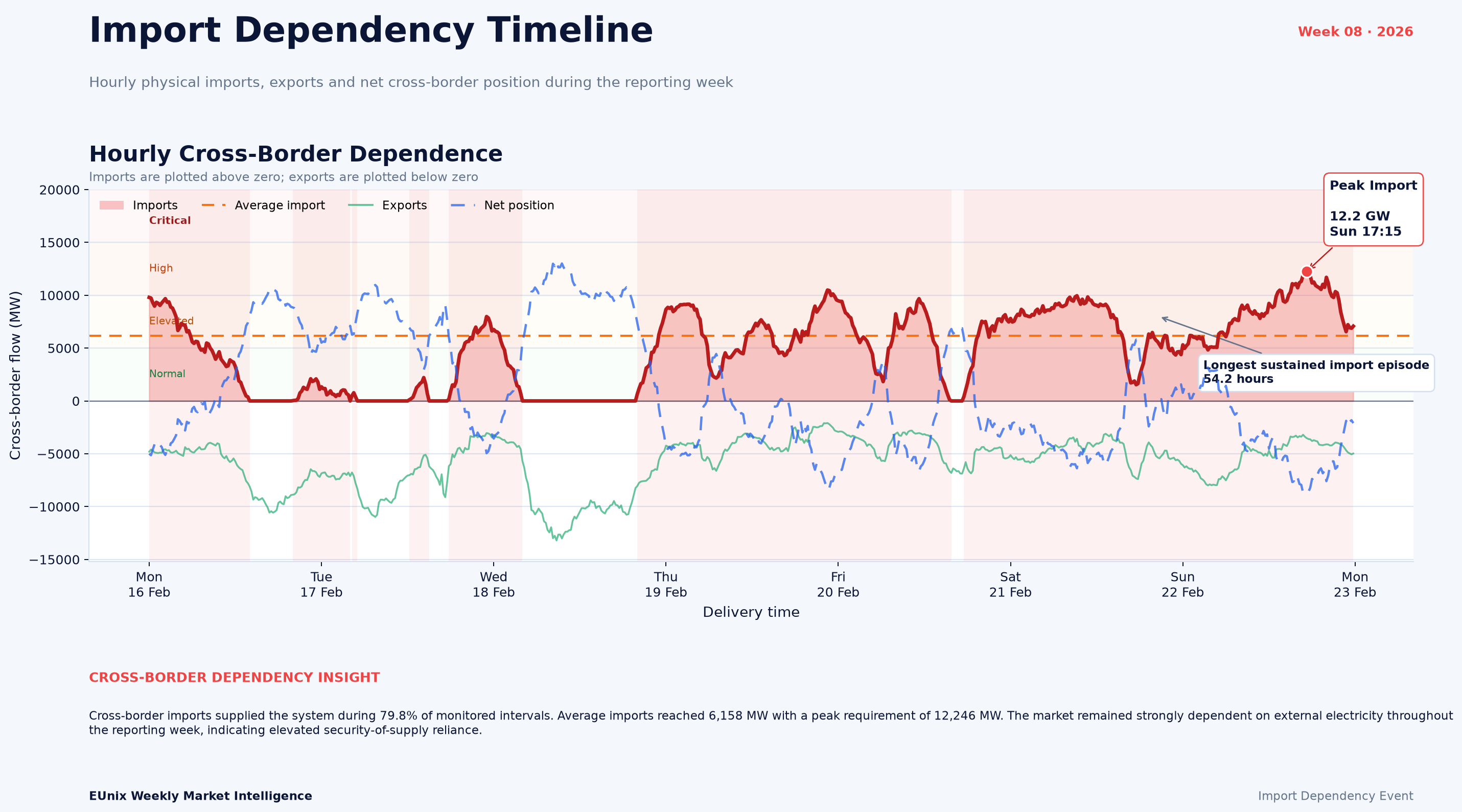
Cross-border flows were central to Germany’s electricity market in Week 8, with imports present during 79.8% of monitored intervals and peaking at 12.25 GW. EUnix ranked the Import Dependency Event as the week’s #1 story, with a 90.8/100 priority score. Imports persisted for 134 hours, highlighting the growing importance of cross-border flexibility while substantial exports continued.
Charts
Market Overview
The strongest import requirement occurred on Sunday, 22 February, when physical imports reached approximately 12.2 GW. Import requirements strengthened considerably toward the latter part of the week, particularly from Thursday through Sunday.
The underlying analytics strongly reinforced the story. The import_dependency analytic recorded an investigation-priority score of 94.34, while scheduled_imports scored 93.36. net_position, at 62.85, provided additional evidence of the changing cross-border position.
Import exposure was also geographically diversified. Austria was the largest individual source of gross imported energy, accounting for 19.9%, followed by Poland and the Czech Republic. The three largest borders together represented 53.3% of measured gross import energy.
Key Observations
Interpretation
Rather, cross-border flexibility was heavily utilised throughout the week.
Imports can reflect several market and system conditions: regional price differentials, renewable-generation patterns, domestic generation availability, congestion, scheduled exchanges, and the economic optimisation enabled by an interconnected European electricity market.
One particularly interesting result is the relationship between imports and residual load.
EUnix analysis produced a correlation of approximately −0.82 between physical imports and residual load during the week. Imports therefore tended to decrease rather than increase as residual load rose.
That weakens a simple interpretation in which imports were predominantly required because domestic residual demand was high. Instead, the observed flows appear to have been influenced strongly by broader cross-border market conditions and regional dispatch economics.
This distinction matters. High import activity is not automatically evidence of insufficient domestic generation capacity. In an interconnected European market, imports can represent economically efficient market coupling just as much as physical supply dependence.
From a security-of-supply perspective, however, the persistence and magnitude of the flows remain important. When cross-border capacity is extensively utilised, changes in neighbouring-system conditions, interconnector availability, congestion or regional scarcity can have a greater influence on domestic market outcomes.
Revenue Insight
Market Outlook
Three developments are particularly worth watching in subsequent weeks: whether high import hours persist, whether peak physical and scheduled imports continue rising, and whether import episodes begin coinciding with high residual load or elevated domestic prices.
A continuation of high import exposure accompanied by tighter interconnector availability would strengthen the security-of-supply dimension of the signal. Conversely, persistent imports accompanied by favourable cross-border price spreads would point more strongly toward economic market coupling rather than physical scarcity.
The next analytical step should therefore combine physical flows, scheduled exchanges, available cross-border capacity, residual load and market prices. That would allow EUnix intelligence to distinguish between economically attractive imports, structural import reliance and scarcity-driven import dependence.
Simulation Note
Written by
Dr. G. O. C. Okwuibe
Quantitative Energy Systems Expert | Electricity Market & BESS
Dr. Godwin Okwuibe is a quantitative energy system expert specializing in electricity markets, battery storage optimization, and flexibility market design. His work focusses on translating complex market dynamics into actionable insights for industry stakehold...