
 Dr. G. O. C. Okwuibe
Import Dependency Event — Week 06, 2026
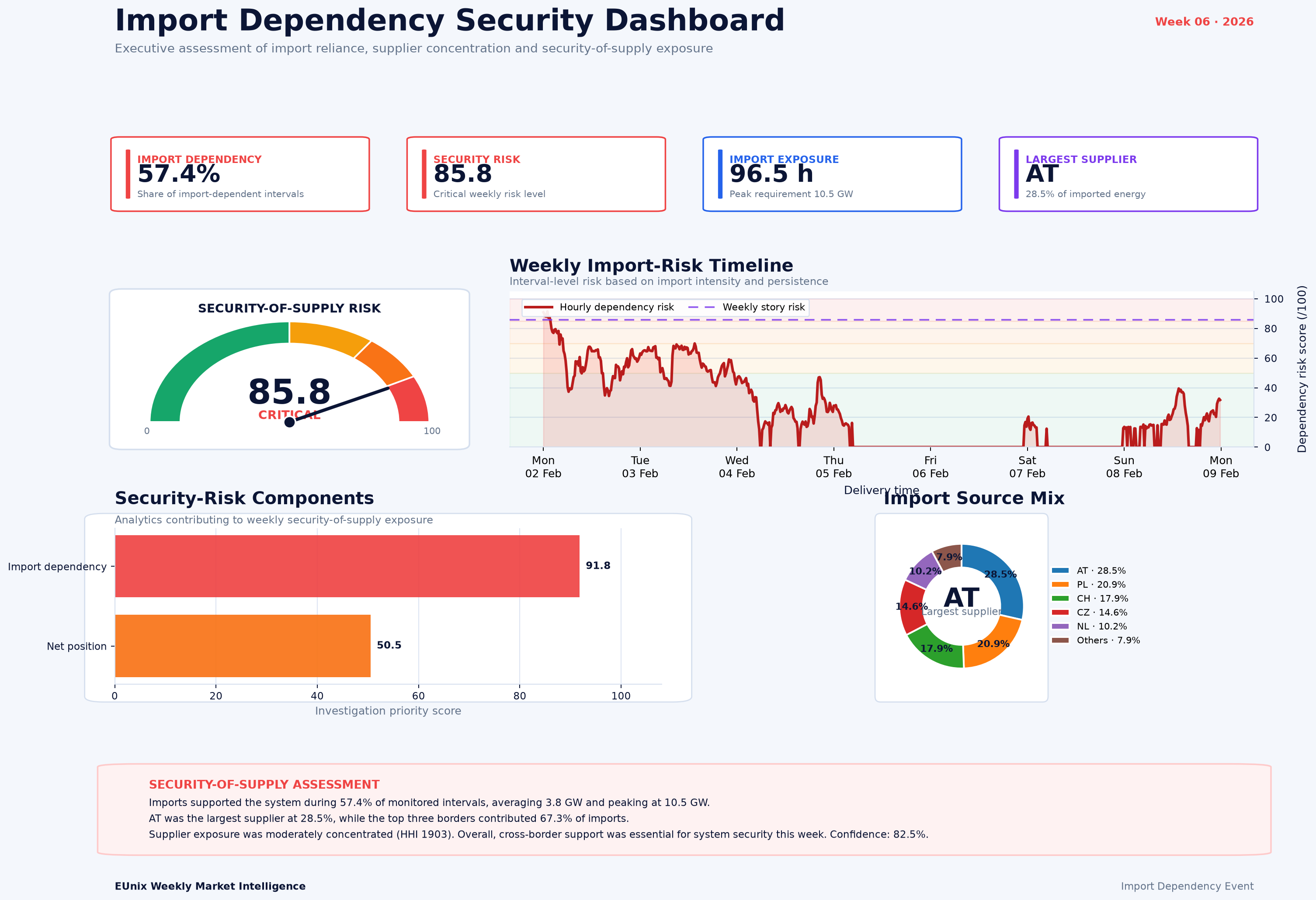
Germany entered Week 06 with unusually strong reliance on cross-border electricity. Physical imports were required during 57.4% of monitored intervals, with peak import requirements reaching 10.5 GW. The pattern highlights how strongly interconnected European markets can support the German system when domestic market conditions favour external supply.
Charts
Market Overview
Cross-border imports supported the German market for approximately 96.5 hours during the week. The most pronounced dependency occurred early in the reporting period, when physical imports peaked at 10,548.9 MW.
The event was not simply a short-lived interconnector spike. Import requirements remained substantial through Monday and Tuesday before declining sharply later in the week. At the same time, scheduled imports reached as high as 15.6 GW, showing the scale of cross-border market activity behind the physical system position.
Key Observations
Interpretation
A high import requirement does not automatically imply domestic generation inadequacy. Imports can arise because neighbouring generation is economically attractive, renewable availability differs across bidding zones, interconnector capacity is available, or market coupling determines that importing is the efficient dispatch outcome.
One particularly interesting signal is the relationship between imports and residual load. EUnix analytics found a −0.73 correlation between physical imports and residual load during the week. Imports generally declined as German residual load increased.
This suggests that the event was not driven purely by domestic demand pressure. Cross-border price differentials, generation availability and European market coupling likely played an important role in determining Germany's import position.
Revenue Insight
Market Outlook
Continued high import requirements combined with tightening interconnector capacity would strengthen the security-of-supply signal. Conversely, falling imports alongside changing regional spreads would indicate that Week 06 primarily represented a temporary economic dispatch opportunity.
For upcoming weeks, the indicators to watch are German residual load, neighbouring-zone price spreads, border utilisation, scheduled-versus-physical exchanges and balancing-market stress.
Simulation Note
Written by
Dr. G. O. C. Okwuibe
Quantitative Energy Systems Expert | Electricity Market & BESS
Dr. Godwin Okwuibe is a quantitative energy system expert specializing in electricity markets, battery storage optimization, and flexibility market design. His work focusses on translating complex market dynamics into actionable insights for industry stakehold...