
 Dr. G. O. C. Okwuibe
Import Dependency Event — Week 14, 2026
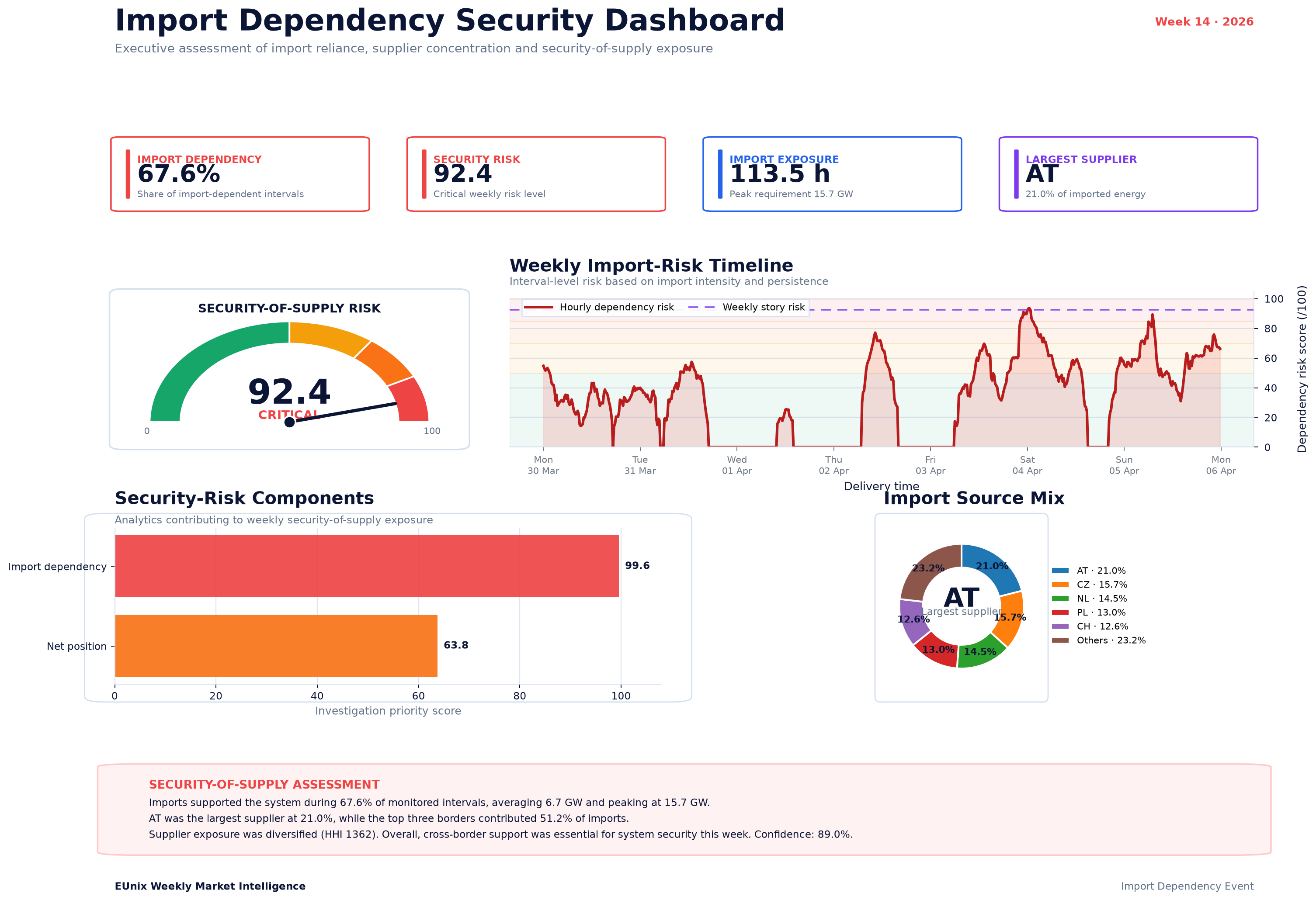
Cross-border electricity played a major role in Germany’s system operation during Week 14. Imports were present during 67.6% of monitored intervals, with a peak physical requirement of 15.72 GW and 113.5 import-dependent hours. EUnix Market Intelligence ranked the event as the #1 story of the week, with a priority score of 92.44, highlighting elevated reliance on neighbouring markets for system flexibility and security of supply.
Charts
Market Overview
The story received a priority score of 92.44, supported by a strong detection strength of 91.84% and confidence of 88.97%.
The dominant signal was a maximum physical import requirement of 15,719.7 MW. Imports were recorded during 67.56% of monitored intervals, equivalent to approximately 113.5 hours of the reporting week.
The supporting analytics strongly reinforced the cross-border story. Import dependency scored 99.58, scheduled imports scored 94.05, and net-position analytics scored 63.76.
The weekly charts also show that import reliance was not uniform. Early in the week, several periods recorded limited or zero imports, while conditions changed significantly from Thursday onward. By the weekend, imports became both larger and more persistent.
Key Observations
Interpretation
Germany imported electricity during more than two-thirds of monitored intervals and reached a substantial peak requirement of almost 15.7 GW. Yet the daily energy profile shows that total weekly exports exceeded imports.
This means cross-border exchanges were functioning dynamically in both directions rather than simply supplying a structurally energy-deficient system.
The most interesting development occurred toward the end of the week. Import requirements increased sharply from Thursday onward and remained elevated through much of the weekend. Saturday produced the maximum physical import requirement, while Sunday also recorded sustained high import levels.
At the same time, the strong negative correlation between imports and residual load suggests that domestic demand pressure alone does not explain these flows. Cross-border price differentials, renewable availability, market coupling, neighbouring-system conditions and scheduled commercial exchanges may all influence whether electricity moves into or out of Germany.
The distinction is therefore important: Week 14 was characterised by high operational reliance on cross-border flexibility, but not by overall weekly net import dependence.
The diversified supplier mix is also relevant from a security-of-supply perspective. Austria was the largest individual source, but its 21% share was not dominant, and the top three suppliers represented only about half of total imported energy. This reduces exposure to disruption at any single border.
Revenue Insight
Market Outlook
Particular attention should be given to import-dependent hours, peak physical imports, scheduled imports, residual-load conditions, supplier concentration and border-level contributions.
If import peaks continue to exceed 15 GW while import-dependent hours remain elevated, Germany's reliance on neighbouring systems for short-term operational flexibility would remain significant.
However, the Week 14 data also demonstrate that high import frequency can coexist with strong exports. Future analysis should therefore continue separating three different concepts:
frequency of import conditions
magnitude of peak import requirements
net weekly import/export energy balance
Tracking those dimensions separately provides a more accurate picture of cross-border security and market dependence than any single import metric alone.
Simulation Note
Written by
Dr. G. O. C. Okwuibe
Quantitative Energy Systems Expert | Electricity Market & BESS
Dr. Godwin Okwuibe is a quantitative energy system expert specializing in electricity markets, battery storage optimization, and flexibility market design. His work focusses on translating complex market dynamics into actionable insights for industry stakehold...