
 Dr. G. O. C. Okwuibe
When Imports Defy Demand: Europe's Cross-Border Electricity Paradox — Week 43, 2026
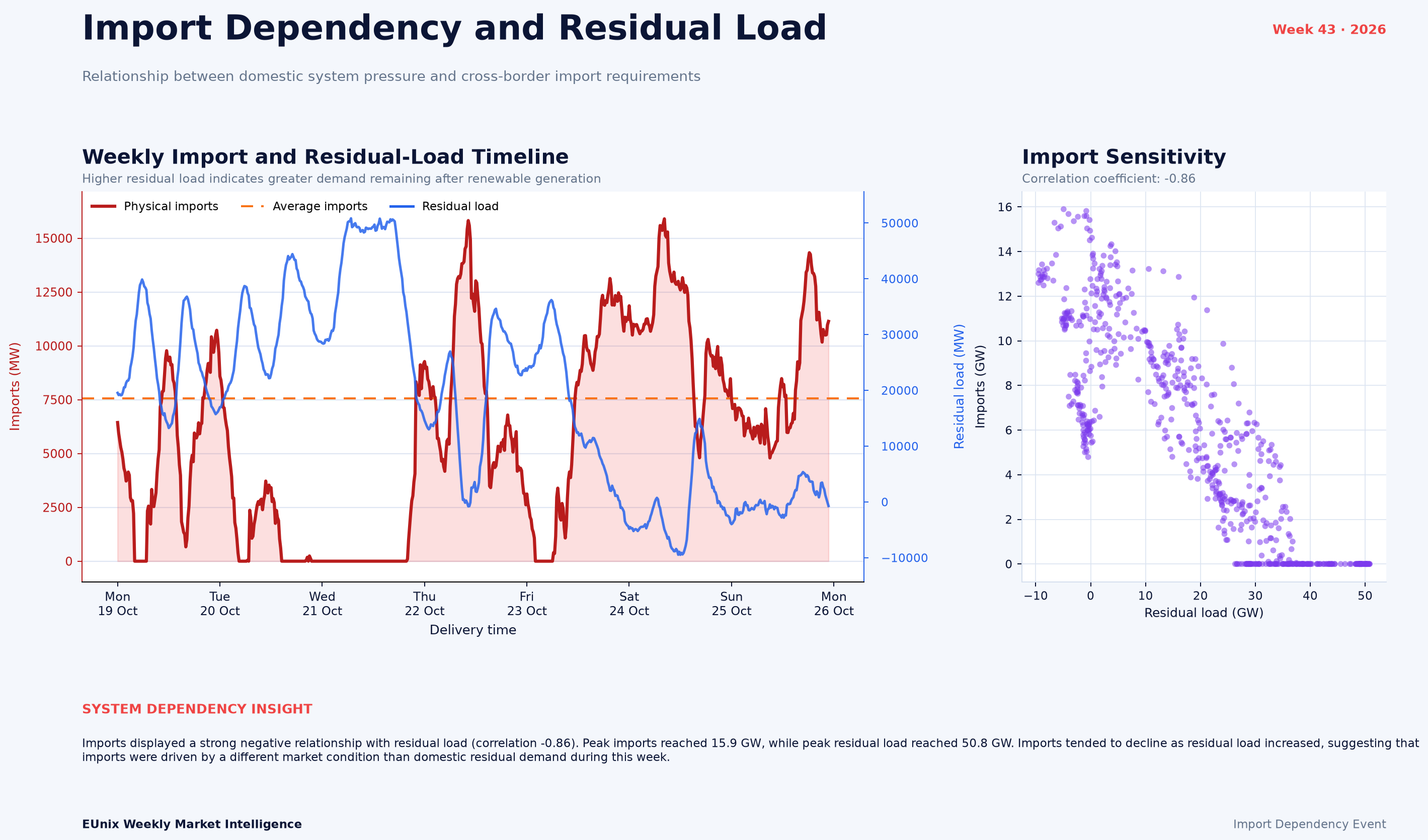
European electricity markets experienced substantial cross-border import dependence during Week 43 (19–25 October 2026). Imports occurred during 77.5% of monitored intervals, reaching 15.9 GW at their peak. Weekly imports totalled 986 GWh against 671 GWh of exports. EUnix Intelligence assigned the Import Dependency Event a critical priority score of 94.3/100, with 89.9% confidence. Surprisingly, imports were strongly negatively correlated with residual load (−0.86), suggesting that cross-border trade reflected more than domestic electricity demand.
Charts
Market Overview
Total imported electricity reached approximately **986 GWh**, compared with 671 GWh of exports, resulting in a net import position of approximately **314 GWh**. However, the weekly balance concealed substantial daily variations. Wednesday, 21 October, recorded only 21 GWh of imports against approximately 219 GWh of exports, while Saturday experienced the opposite pattern, with imports reaching 259 GWh against approximately 42 GWh of exports.
Import requirements intensified considerably toward the end of the reporting week. Thursday recorded a peak import requirement of 15.8 GW, followed by 13.1 GW on Friday, 15.9 GW on Saturday and 14.3 GW on Sunday. The import-dependency timeline identified a sustained import episode lasting approximately **65.5 hours**, demonstrating that cross-border reliance extended beyond isolated periods of elevated demand.
The geographical distribution of imports also revealed the importance of neighbouring electricity markets. Austria contributed the largest reported share at 19.1%, followed by Poland at 16.9% and the Czech Republic at 15.4%. Together, these three borders accounted for **51.4% of the reported import-source mix**, while the import concentration index reached 1,289, indicating a relatively diversified distribution across the monitored borders.
Perhaps the most interesting development was the relationship between imports and domestic residual electricity demand. The EUnix analysis identified a **strong negative correlation of −0.86** between physical imports and residual load. Imports tended to increase when residual demand was relatively low and decrease when residual demand was elevated. This counterintuitive pattern suggests that cross-border electricity flows were influenced by factors beyond domestic residual-load requirements.
Key Observations
Interpretation
One possible explanation is the relative competitiveness of electricity generation across interconnected markets. When electricity is available at lower prices in neighbouring countries, importing electricity may be economically attractive even when domestic residual demand is relatively low. Conversely, periods of elevated domestic residual load may coincide with reduced imports if neighbouring markets face their own supply constraints or more attractive domestic market conditions. **The supplied data do not establish which of these mechanisms dominated during Week 43**, but they demonstrate why residual demand alone is insufficient to explain cross-border trading behaviour.
The considerable variation between Wednesday and Saturday further illustrates the dynamic nature of interconnected electricity markets. Wednesday's substantial exports indicate that the monitored system was capable of supplying electricity to neighbouring markets during certain periods. By Saturday, the balance had shifted toward sustained imports, highlighting how quickly cross-border trading positions can change.
From a security-of-supply perspective, the duration and intensity of import requirements deserve attention. The longest continuous import episode lasted approximately 65.5 hours, while peak imports approached 16 GW. These conditions highlight the importance of maintaining sufficient cross-border transmission availability and coordinating electricity-system operations with neighbouring countries. However, **high imports do not automatically indicate a shortage of domestic generation or an immediate security-of-supply threat**. Imports can also reflect economically efficient electricity trading.
The distribution of imports across several neighbouring borders provides an additional dimension to the analysis. Although Austria, Poland and the Czech Republic accounted for more than half of the reported import-source mix, the concentration index of 1,289 suggests that imports were not overwhelmingly dependent on a single border. Nevertheless, geographical diversification alone does not eliminate exposure to regional market disturbances, transmission constraints or simultaneous supply shortages across interconnected electricity systems.
Revenue Insight
Market Outlook
For electricity-market analysts, the strong negative relationship between imports and residual load presents an important area for further investigation. Combining physical electricity flows with day-ahead prices, renewable-generation forecasts, generation availability and scheduled commercial exchanges could help explain why imports increased during periods of relatively low residual demand.
For transmission system operators, sustained import episodes highlight the importance of cross-border coordination, transmission-capacity management and contingency planning. Maintaining sufficient operational flexibility becomes particularly relevant when neighbouring electricity systems experience simultaneous changes in generation availability or electricity demand.
For electricity traders and flexibility providers, the findings suggest that regional market conditions should be considered alongside domestic demand and generation forecasts. Cross-border electricity flows can provide valuable information about market conditions, although their predictive usefulness must be established through further analysis.
**The central lesson from Week 43 is that electricity import dependence cannot be understood through domestic demand alone.** Interconnected electricity markets respond to regional supply conditions, economic incentives and transmission constraints. Understanding these interactions is essential for assessing security-of-supply exposure, improving market forecasts and identifying commercially relevant flexibility opportunities.
Simulation Note
Written by
Dr. G. O. C. Okwuibe
Quantitative Energy Systems Expert | Electricity Market & BESS
Dr. Godwin Okwuibe is a quantitative energy system expert specializing in electricity markets, battery storage optimization, and flexibility market design. His work focusses on translating complex market dynamics into actionable insights for industry stakehold...