
Dr. G. O. C. Okwuibe Dr. G. O. C. Okwuibe
All Reports / Week 42, 2026
Intelligence Report W42 · 2026 Dr. G. O. C. Okwuibe 20 Oct 2026

When Renewables Reshape the Grid: The Growing Cost of Flexibility — Week 42, 2026

European electricity-system operations faced significant flexibility challenges during Week 42 (12–18 October 2026), as renewable generation depressed midday residual demand and intensified subsequent ramping requirements. EUnix Intelligence ranked Duck Curve and Flexibility Stress as the week's leading story, scoring 88.4/100 with 79.9% confidence. The deepest daily duck curve reached 33.9 GW, while the strongest upward ramp reached 18.9 GW/h. With 68 critical ramp intervals identified, the findings highlight growing opportunities for battery storage and demand response.

📈
Chart
📊
European electricity-system dynamics during Week 42 highlighted the operational challenges associated with integrating variable renewable generation. Average electricity demand reached **54.3 GW**, while renewable generation averaged **24.6 GW**, leaving an average residual load of **29.7 GW**. The resulting demand profile exhibited pronounced midday depressions followed by rapid afternoon and evening recoveries, creating substantial requirements for flexible generation, energy storage and demand-side management.

The daily residual-load analysis revealed a recurring duck-curve pattern, with the lowest demand remaining after renewable generation generally occurring around **11:00**. The deepest daily duck curve was recorded on Thursday, 15 October, reaching **33.9 GW**, compared with a weekly average depth of 22.6 GW. The minimum observed hourly residual load fell to 9.0 GW, demonstrating how renewable output can substantially reduce the electricity demand that must be supplied by other generation sources.

However, the operational challenge extended beyond the midday decline. As renewable generation decreased and electricity demand remained elevated, the system experienced pronounced upward residual-load ramps. Wednesday, 14 October, recorded the largest evening recovery of **43.9 GW**, alongside the strongest upward hourly ramp of **18.9 GW/h**. These rapid transitions highlight the importance of dispatchable flexibility capable of responding to changing system conditions.

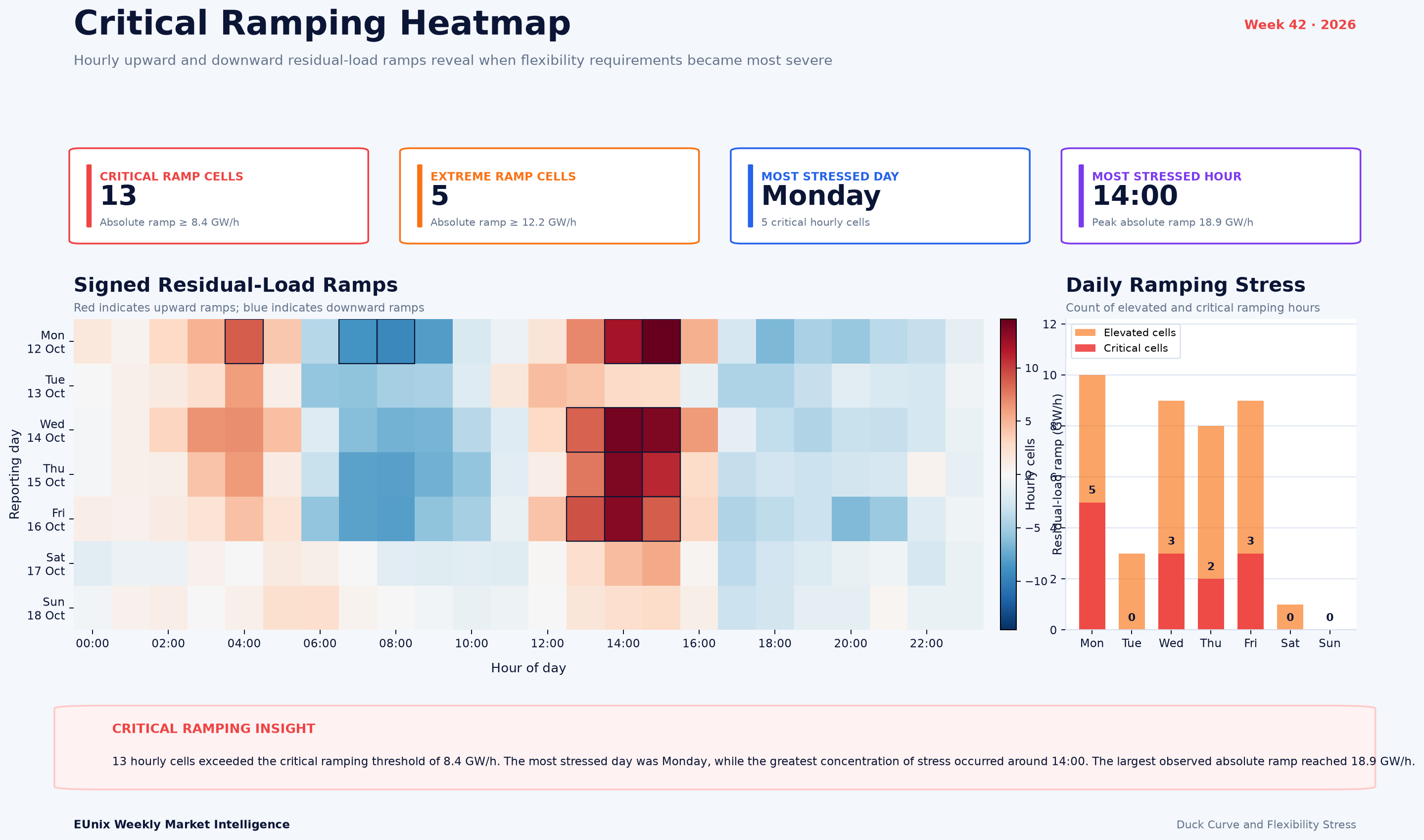
The EUnix Intelligence Platform identified **68 critical residual-load ramp intervals** exceeding the analytical threshold of 8.4 GW/h. The strongest downward ramp reached 12.7 GW/h on Monday, 12 October. Although both upward and downward flexibility requirements were observed, the most pronounced upward ramps were concentrated around the afternoon recovery period.

These developments positioned Duck Curve and Flexibility Stress as the highest-ranked intelligence story for the week, receiving a priority score of **88.4/100**, detection strength of approximately 95.4%, and confidence of 79.9%. The findings demonstrate that renewable integration increasingly requires attention not only to generation capacity but also to the timing, speed and availability of flexible resources.
🔍
1 Significant midday residual-load depression:** The deepest daily duck curve reached 33.9 GW on Thursday, 15 October, compared with a weekly average of 22.6 GW.
2 Strong evening recovery requirements:** Wednesday recorded the largest evening residual-load recovery of 43.9 GW, highlighting the substantial flexibility needed as renewable generation declined.
3 Rapid hourly ramping:** The maximum upward ramp reached 18.9 GW/h on Wednesday at 14:00, while the strongest downward ramp reached 12.7 GW/h on Monday at 07:00.
4 Recurring critical ramping conditions:** EUnix identified 68 intervals exceeding the critical ramp threshold of 8.4 GW/h, indicating that flexibility requirements extended beyond isolated extreme events.
5 Renewable generation reshaped demand patterns:** Average renewable generation reached 24.6 GW against average electricity demand of 54.3 GW. Saturday recorded the highest daily renewable share at 53.9%.
6 Midday emerged as a strategic flexibility window:** Daily residual-load minima occurred around 11:00 on average, identifying a potentially valuable period for battery charging and flexible electricity consumption.
7 Substantial storage and demand-response opportunities:** The platform identified 42 hours of top-quartile storage-charging conditions and 42 hours of top-quartile demand-response conditions.
8 Weekday flexibility stress exceeded weekend conditions:** The most pronounced duck curves and ramping requirements occurred during weekdays, while the shallowest daily duck curve reached only 2.5 GW on Sunday.
9 Flexibility requirements received a critical classification:** The EUnix Flexibility Requirement Dashboard recorded an overall assessment of 88.4/100, supported by strong ramping, storage and demand-response signals.
🧠
The developments observed during Week 42 illustrate an increasingly important challenge in renewable-dominated electricity systems: **the timing of electricity generation is becoming as important as the quantity generated**. High renewable production can substantially reduce residual demand during certain hours, but the subsequent decline in renewable output creates rapid requirements for alternative generation or demand adjustment.

The relationship between renewable generation and residual load is particularly visible in the average intraday system profile. Renewable output increased toward late morning, reaching approximately 43 GW around 10:00–11:00, while residual load declined toward its daily minimum. As renewable generation decreased during the afternoon, residual load recovered sharply, creating a pronounced requirement for upward flexibility.

This pattern has important implications for conventional generation, electricity storage and demand-side flexibility. Conventional generators may need to reduce output during renewable-rich periods before increasing production rapidly during the afternoon. Such operating patterns can increase cycling requirements and place additional demands on ramping capabilities.

Battery energy storage systems offer a potential solution by absorbing electricity during periods of low residual demand and discharging when system requirements increase. However, storage effectiveness depends on available energy capacity, power ratings, state-of-charge management and the duration of the required flexibility response. Similarly, demand-response programmes can reduce or shift consumption during periods of elevated residual load, reducing the need for additional generation.

An important distinction is that **high residual-load ramping does not automatically translate into high electricity prices or guaranteed flexibility revenues**. Market outcomes depend on generation availability, network constraints, market-clearing arrangements and the actual procurement of flexibility services. Nevertheless, the observed patterns provide strong operational evidence for investigating storage deployment, flexible demand and coordinated market participation.
💰
The flexibility patterns identified during Week 42 suggest several potential revenue opportunities for battery storage operators, aggregators and flexible electricity consumers. However, unlike the battery arbitrage analysis presented in Week 41, the current dataset does not include electricity-price spreads or simulated financial returns. Consequently, the opportunities discussed here represent **technical and market-participation potential rather than verified revenues**. For battery operators, the recurring midday residual-load depressions create potentially attractive charging periods, particularly when renewable generation is abundant. The subsequent afternoon and evening recovery provides possible discharge opportunities. The EUnix platform identified 42 hours of top-quartile storage-charging conditions, with the strongest storage opportunity signal reaching **84.4/100 on Friday at 10:00**. Demand-response operators could benefit from shifting electricity consumption away from periods of elevated residual load and rapid upward ramping. The platform identified 42 hours of top-quartile demand-response conditions, with the strongest signal reaching **81.2/100 on Monday at 15:30**. Industrial consumers, commercial facilities and aggregators with controllable demand could potentially exploit these periods through suitable market arrangements. The distinction between available flexibility and economically valuable flexibility is particularly important. While 42 hours were classified as relatively attractive for storage charging, only 3.5 hours exceeded the higher storage-opportunity threshold of 75/100. Similarly, only 1.2 hours exceeded the corresponding demand-response threshold. This suggests that the strongest opportunities were concentrated in relatively short periods rather than uniformly distributed throughout the week. For investors and asset operators, the findings reinforce the importance of combining technical flexibility assessments with electricity-market prices, battery degradation costs, network charges and market-access requirements. A robust revenue assessment would require dispatch optimization across relevant electricity and flexibility markets rather than relying solely on residual-load patterns.
🔭
The developments observed during Week 42 suggest that managing intraday flexibility will remain an important consideration for electricity systems with substantial variable renewable generation. The recurring midday depressions and afternoon recovery periods demonstrate how changes in renewable output can create significant operational requirements even when average electricity demand remains relatively stable.

Battery storage and demand-response resources are well positioned to address these challenges, particularly where their operational capabilities align with the timing and duration of system requirements. The identified charging and demand-response windows provide useful signals for further investigation into storage scheduling, industrial load shifting and flexibility-market participation.

For system operators, the findings highlight the importance of forecasting residual-load ramps alongside conventional electricity-demand and renewable-generation forecasts. Accurate identification of rapid upward and downward transitions can support reserve planning, generation scheduling and the procurement of flexibility services.

For market participants, the next analytical priority should be determining how these physical flexibility requirements translate into market prices and achievable revenues. Combining residual-load forecasts with day-ahead, intraday and balancing-market information would provide a stronger basis for evaluating the commercial value of flexible assets.

**The central message from Week 42 is clear: renewable integration is not only a question of generating more clean electricity, but also of ensuring that the electricity system can respond efficiently when renewable output changes.** The economic value of flexibility will depend on how effectively these operational requirements are translated into coordinated dispatch and market opportunities.
🔬
This analysis uses electricity-system data sourced from the **European Network of Transmission System Operators for Electricity (ENTSO-E)** and processed through the **EUnix Intelligence Platform**. The platform integrates electricity demand and renewable-generation data, calculates residual-load profiles, evaluates intraday duck-curve depth and ramping requirements, and identifies potential storage and demand-response opportunities. Its analytical workflow combines automated data processing, statistical evaluation, opportunity scoring and intelligence-story detection. The reported flexibility scores represent analytical indicators rather than simulated market revenues or confirmed commercial opportunities.
Dr. G. O. C. Okwuibe

Written by

Dr. G. O. C. Okwuibe

Quantitative Energy Systems Expert | Electricity Market & BESS

Dr. Godwin Okwuibe is a quantitative energy system expert specializing in electricity markets, battery storage optimization, and flexibility market design. His work focusses on translating complex market dynamics into actionable insights for industry stakehold...

View full profile